Garage Floor Epoxy Coating Salt Lake City
Two-day prep-and-pour: diamond grind, crack repair, full broadcast flake, polyaspartic topcoat. Built to survive Utah winters, road salt, and hot tires. Free on-site estimate.
A garage floor coating in Salt Lake City has to do three things at once: lock out moisture from the slab below, shrug off road salt and brine that comes in on tires from Big Cottonwood, Little Cottonwood, and Parley’s canyons, and stay bonded through ninety freeze-thaw cycles a winter. The cheap roller kit from a hardware store can’t do any of those things. Our two-day garage floor epoxy coating — diamond-ground prep, vapor-block primer, full broadcast flake, polyaspartic topcoat — can. Call (385) 600-6216 for a free on-site estimate.
What Garage Floor Epoxy Coating Means in Utah
Most “epoxy” floors sold around the Wasatch Front are actually multi-layer hybrid coating systems. The label “epoxy” is a holdover from the 1990s when single-component epoxy paint was the only product on the market. The system we install on Salt Lake City garages today is a layered build: a 100% solids epoxy basecoat for adhesion and slab bonding, a full broadcast of vinyl flake into the wet basecoat for color, texture, and slip resistance, and a polyaspartic topcoat for UV stability, chemical resistance, and impact strength.
Why the layered system matters in Utah: epoxy alone yellows under UV, softens slightly under heat, and is vulnerable to magnesium chloride brine. Polyaspartic alone is hard to bond to bare concrete without a primer. Combining the two — epoxy for adhesion, polyaspartic on top for protection — gives you a floor that handles the Salt Lake Valley climate the way a single-product system can’t.
Project Details
| Timeline | Two days on site, full cure within 24 hours of final coat |
|---|---|
| Install Days | Day 1: grind, repair, prime. Day 2: basecoat, flake broadcast, topcoat. |
| Materials | Penntek or Wolverine Coatings 100%-solids epoxy basecoat, Torginol vinyl flake, polyaspartic topcoat |
| Warranty | 15-year topcoat product warranty, 5-year workmanship warranty, transferable to next homeowner |
| Crew Size | 2-3 installers per garage, no subcontractors |
| Permit Required | No permit needed for residential coating systems in Salt Lake City |
| Pricing | Quoted per job after free on-site inspection — every quote is itemized in writing |
Our Two-Day Garage Coating Process
Moisture and porosity testing
Before we quote a coating system, we test the slab with a calibrated moisture meter and a calcium chloride test. Salt Lake Valley slabs sit on alkaline soils that wick moisture up through the concrete. If your slab is wet, we either use a moisture-tolerant primer or we tell you the floor isn’t a candidate — we don’t coat over a problem.
Diamond grinding
Day one starts with full mechanical surface prep. A diamond grinder with HEPA-filtered dust extraction strips old paint, old sealers, and surface contamination, and opens the concrete profile for coating adhesion. This is the step the lowball quotes skip — and skipping it is the #1 reason garage coatings fail in Utah.
Crack and pitting repair
After grinding, every crack and divot is filled with polyurea crack filler and shaved flush. A coating system telegraphs every imperfection underneath it; we fix them first.
Vapor-block primer (when needed)
On slabs that showed elevated moisture readings, we apply a moisture-tolerant primer before the basecoat. This is what stops blistering and delamination six months after install. Most coating crews skip this step entirely.
Basecoat and flake broadcast
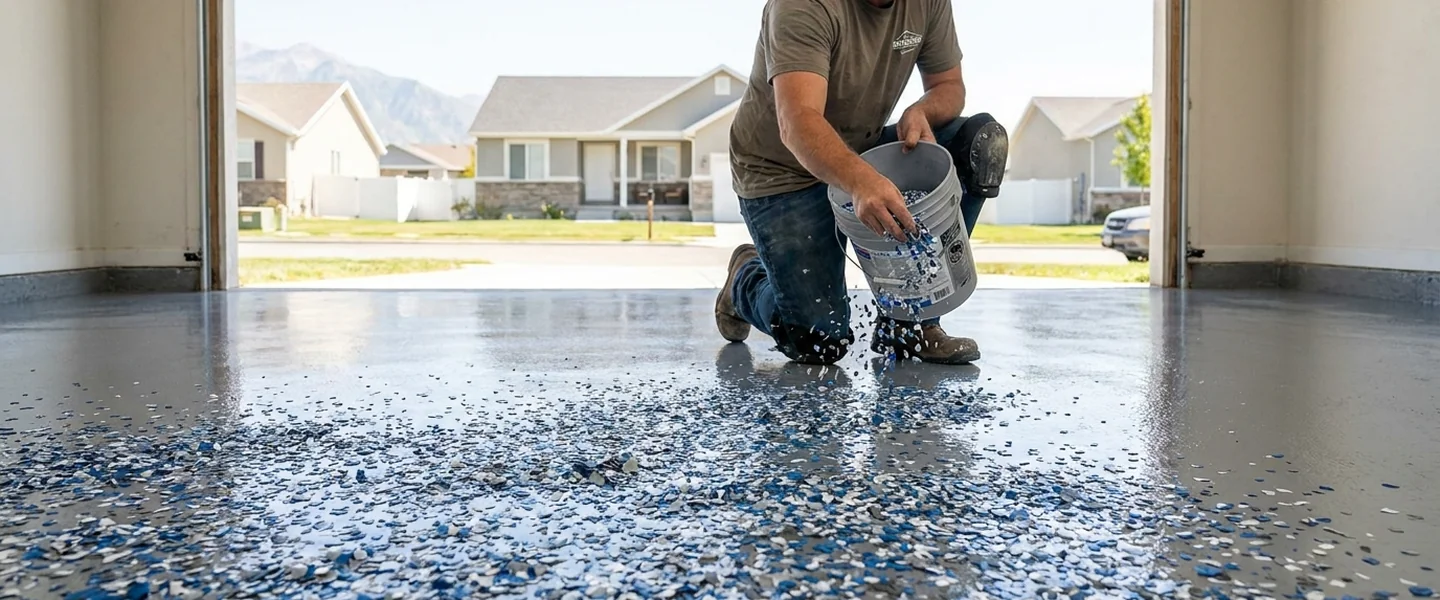
Day two starts with the 100%-solids epoxy basecoat rolled into the prepped slab. While the basecoat is wet, we broadcast Torginol vinyl flake to full rejection — meaning we keep throwing flake until no more will stick. Full broadcast (not a partial 30% broadcast) is what gives you the textured, slip-resistant surface that handles wet boots in winter.
Polyaspartic topcoat and walk-through
The next morning we scrape the excess flake, vacuum the surface, and roll the polyaspartic topcoat. Within four hours you can walk on it, and within 24 hours you can park on it. We do a written walk-through with you before signing the warranty.
Materials We Use on Salt Lake City Garages
| Penntek or Wolverine epoxy basecoat | 100% solids, low-VOC, designed for full-flake broadcast systems. Bonds to diamond-ground concrete with mechanical adhesion. |
|---|---|
| Torginol vinyl flake | Industry-standard color flake; UV-stable; we stock 20+ blend options including Wasatch granite, slate gray, mountain mist, and copper canyon. |
| Polyaspartic topcoat | UV-stable, chemical-resistant top layer that doesn’t soften under heat or yellow in sunlight. Cures fast enough to park on within 24 hours. |
| Polyurea crack filler | Used in step 3 for crack repair. Flexes with the slab through freeze-thaw cycles rather than cracking back open the first winter. |
Common Garage Floor Scenarios in Salt Lake City
The old paint lifted
Homeowners who tried a big-box paint kit five or ten years ago and now have lifting, peeling, hot-tire pickup, and salt staining. We grind off everything — old paint, contamination, surface laitance — before we coat. Stripping is built into our quote.
The slab is pitted or scaled
Common on Salt Lake City garages built before 1980 where the original slab took years of road salt and brine without protection. We fill the pits, grind the surface flat, and the new coating bridges the repaired surface.
The garage doubles as a shop
Cottonwood Heights and Holladay homeowners who use the garage as a woodshop or auto bay want chemical resistance and impact strength. The polyaspartic topcoat handles oil, brake fluid, gasoline, and dropped tools without staining or chipping.
The garage is brand new construction
New-build garages in Daybreak, Herriman, and Lehi often have green concrete that needs at least 28 days of cure before any coating. We schedule the install around the slab’s cure date, not the builder’s timeline.
Why Salt Lake City Homes Need This Specifically
The Salt Lake Valley has a unique combination of stressors: heavy magnesium chloride brine on canyon and freeway roads from October through April, freeze-thaw cycles that hammer porous concrete, alkaline soils that drive moisture up through the slab, and ski-season abuse from gravel, sand, and salt tracked in on tires. Most coating systems sold in warmer climates were never engineered for any of that. Our system was specified specifically for the Wasatch Front conditions — a polyaspartic topcoat over a moisture-tolerant epoxy basecoat is the only combination that handles all four stressors at once.
A garage floor coating that doesn’t include moisture testing, doesn’t include diamond grinding, and doesn’t use a polyaspartic topcoat is going to fail in Utah. Not “might” — will. We’ve ground off enough failed coatings to know.
Warranty in Detail
Our garage floor coating warranty has two parts: a 15-year product warranty on the polyaspartic topcoat (covers UV chalking, delamination, and chemical staining from common automotive fluids) and a 5-year workmanship warranty (covers any adhesion failure attributable to our installation). Both are transferable to the next homeowner — a real selling point if you ever list the house.
What’s covered
- Topcoat delamination, peeling, or lifting from the basecoat
- UV chalking or yellowing within the warranty window
- Chemical staining from oil, brake fluid, gasoline, antifreeze
- Adhesion failure attributable to our prep or installation
What’s not covered (so we tell you up front)
- Damage from impact (dropped engine block, sledgehammer, etc.)
- Damage from coatings or sealers applied by anyone else after our install
- Failure caused by structural slab movement — if the slab cracks because the soil moved, the coating telegraphs the crack
- Studded snow tire wear in the same spot every day — metal studs will eventually scratch any coating
That last category is honest disclosure most coating companies bury in fine print. We say it out loud so there are no surprises.
How We Quote (Without Quoting on the Phone)
We do not quote garage floor coatings over the phone. The reason is simple: a fair quote requires us to see the slab. Square footage, condition, moisture readings, crack count, old-coating presence, flake choice, and access all change the number significantly. A phone quote would be a guess, and guess-quotes are how lowball bids end up costing the homeowner three times the original number in change-orders.
What you can expect: schedule a free on-site visit, we measure the garage and test the slab, we walk you through flake options and coating-system choices, we leave you with a written itemized quote on the spot or via email within 24 hours. No pressure to sign same-day. No “today-only” pricing tricks. Call (385) 600-6216 to schedule.
Free On-Site Estimate
Same-week appointments across the Salt Lake Valley. No pressure, no on-the-spot signing.
After the Install
You’re not on your own after the polyaspartic cures. We schedule a 30-day check-in to walk the floor with you, look for any cure marks or edge work that needs touch-up, and answer questions about cleaning. At 12 months we schedule a follow-up to inspect the floor through a full Utah winter — that’s when most coating failures would show, and on our system they don’t.
Cleaning your new floor
Sweep loose grit weekly so it doesn’t act like sandpaper under tires. Wash with warm water and a pH-neutral cleaner when needed. Skip degreasers with citric acid or harsh solvents — they’re not necessary on a polyaspartic surface and over time they can dull the gloss. Wipe up oil and chemical spills the same day, but you don’t need to panic about it.
Frequently Asked Questions
How long does a polyaspartic-topped garage floor last in Salt Lake City?
Real-world life on a Wasatch Front garage with our system is 15 to 20 years before any recoating is required. Studded snow tires, daily heavy abuse, and unusual chemical exposure can shorten that. Standard daily-driver use with periodic cleaning typically gets the full 20 years.
Epoxy vs polyaspartic — which should I get?
You should get both. The systems sold as “polyaspartic only” don’t bond well to bare concrete; the systems sold as “epoxy only” can yellow, soften, and stain. Our build uses epoxy for adhesion and polyaspartic for protection — the right product in the right layer.
Can you install in winter in Salt Lake City?
Yes, year-round. We need the garage to be heated to at least 55°F during the cure window and the slab to be dry. We work in unheated detached garages only outside cold-snap weeks. We’ll evaluate your garage’s heating during the estimate.
Will my new floor be slippery when wet?
No. The full broadcast flake gives the floor a textured surface that’s actually less slippery than smooth painted concrete, even when wet from ski-boot drips. If you want extra grip we can add a polyurea slip-additive to the topcoat at no extra charge.
How long until I can park on it?
Walk-on traffic in 4 to 6 hours after the topcoat. Vehicle traffic in 24 hours. Full chemical cure (oil, brake fluid resistance) at 72 hours. The polyaspartic topcoat is what makes that fast cure possible — a traditional epoxy-only system would need 5 to 7 days.
How do you handle moisture vapor emission on slab-on-grade?
We test every slab. If the calcium chloride test shows elevated vapor emission, we use a moisture-tolerant primer designed for high-MVE applications before the epoxy basecoat. This is the #1 cause of coating failure in Utah and it’s the step most installers skip.
Do you do the work or sub it out?
We do every floor ourselves. The crew that quotes is the crew that installs. No day-laborer subs, no franchise installers from out of state. Local crew, local accountability.
What about hot-tire lift?
Hot tires are the #1 failure mode on cheap garage paint and on professionally installed epoxy-only systems when prep was skipped. Our polyaspartic topcoat is engineered for hot-tire resistance and won’t soften under summer Utah heat. Bonded to a diamond-ground slab, it doesn’t lift.
How much does it cost?
Every garage is different. Square footage, slab condition, flake choice, moisture levels, and access all change the number. Call (385) 600-6216 for a free on-site inspection and a written itemized quote — no obligation, no high-pressure sales.
Related Reading
- Polyaspartic vs Epoxy: What Lasts Longer in Salt Lake City?
- Why Hot Tires Lift Epoxy (and How a Proper Topcoat Stops It)
- Moisture Vapor Emission: The Silent Killer of Salt Lake City Garage Floors
Also serving Sandy, Draper, Holladay, and the rest of the Salt Lake Valley.
What You Get in Our Quote vs. the Lowball Bid
We don’t compete on the lowest sticker price — we compete on the quote that gets the job actually done. Here is what is included in every quote we write, and the cut-corners that show up in cheaper bids.
Included in our written quote
- Concrete moisture + porosity testing
- Crack and pitting repair before coating
- Full diamond-grind surface prep
- Written quote with flake/coat specs
- Cure-time schedule you can plan around
- 5-year warranty against delamination
Cut corners in the lowball bid
- Coating over uncured or wet slab
- Roller-only prep (no diamond grind)
- Lowball quotes without crack repair
- Subbed-out installation
- No moisture testing before coat
- Warranties full of fine print