Concrete Repair & Coating Salt Lake City
Crack repair, divot fill, and resurface before coating — restoring degraded slabs in one mobilization. Common on older Salt Lake Valley garages and basements.
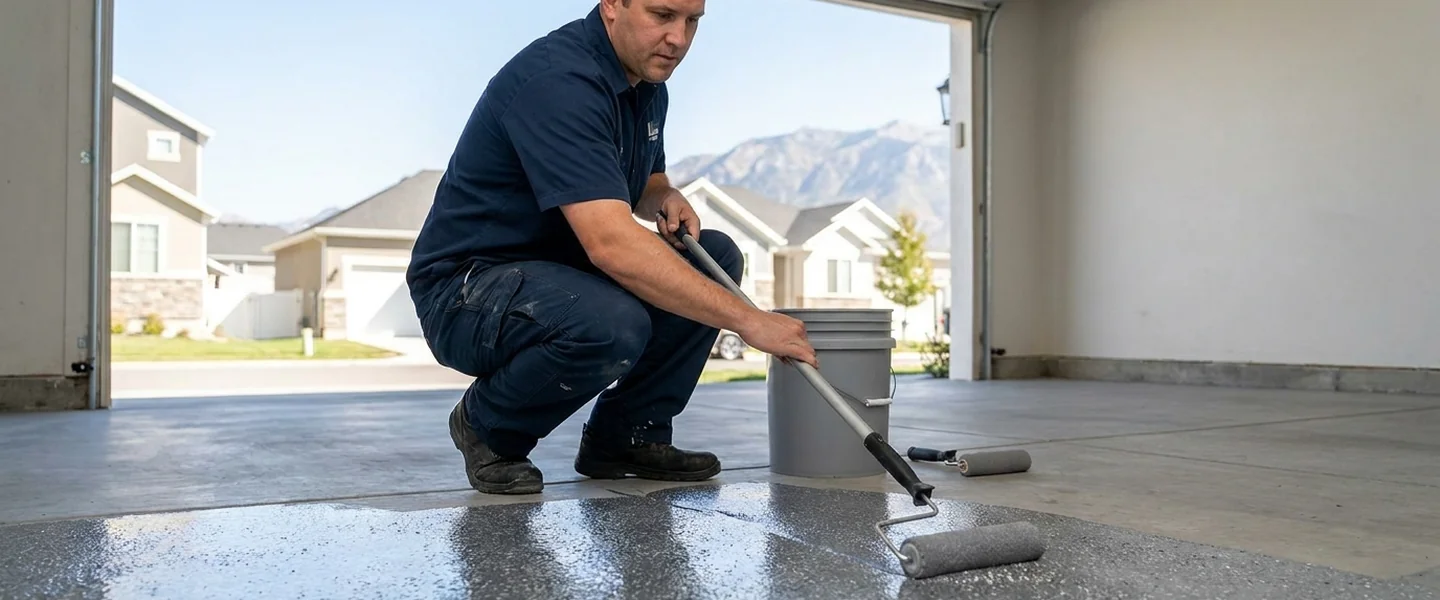
Some Salt Lake City garage and basement slabs need more than a coating — they need real repair first. Decades of road salt, freeze-thaw cycles, hot tires on cheap paint, and dropped tools leave concrete with cracks, divots, pitting, scaling, and surface spalling. We do the repair and the coating in one mobilization: polyurea crack fill, divot repair with rapid-set concrete, slab resurfacing where needed, then the full coating system on top. The result is a floor that looks like new concrete with a designer finish. Call (385) 600-6216 for a free on-site evaluation.
What Concrete Repair Means in Utah
A coating telegraphs every imperfection underneath it. If you put a polyaspartic-topped flake system over a slab with quarter-inch cracks, the cracks will show through — visible as raised lines or stress fractures within months. Worse, those cracks open and close with freeze-thaw cycles and tear at the coating’s bond.
The right approach for damaged Salt Lake Valley slabs is to repair the substrate before any coating goes down. We use polyurea crack filler (flexes with freeze-thaw and doesn’t crack back open), rapid-set concrete patch for larger divots and spalled areas, and a self-leveling concrete overlay when the surface profile is too far gone for spot repair. Then the same diamond-grind-prime-basecoat-topcoat coating system goes on as if the slab were new.
Project Details
| Timeline | Two to four days on site depending on extent of repair |
|---|---|
| Install Days | Day 1: assess, repair cracks and divots, grind. Day 2: resurface if needed, prime. Day 3-4: basecoat, flake, topcoat. |
| Materials | Polyurea crack filler, rapid-set patch, self-leveling overlay, 100%-solids epoxy basecoat, polyaspartic topcoat |
| Warranty | 15-year topcoat warranty, 5-year workmanship on coating, 1-year warranty on substrate repair |
| Crew Size | 2-3 installers |
| Permit Required | No permit for residential concrete repair and coating in Salt Lake City |
| Pricing | Quoted per job after free on-site inspection — every quote is itemized in writing |
Our Repair-and-Coat Process
Slab assessment
We walk the slab and document every crack, divot, pit, and spalled area. Photos and measurements go in your quote so you see exactly what we’re repairing.
Crack repair
Cracks are cleaned out, vacuumed, and filled with polyurea crack filler. Polyurea flexes through freeze-thaw — the cracks don’t reopen the first winter.
Divot and pit repair
Rapid-set concrete patch in larger divots, mechanical pit fill in smaller pitting. Shaved flush after cure.
Slab resurfacing (if needed)
For severely degraded slabs — broad spalling, surface delamination, or out-of-level slabs — we pour a thin self-leveling concrete overlay. Adds maybe 1/8 to 1/4 inch of height and creates a fresh surface to coat.
Diamond grind
Full mechanical surface prep after the repairs cure. Levels the patch material flush, opens the profile for coating adhesion.
Standard coating system
Primer, basecoat, flake or aggregate broadcast, polyaspartic topcoat. Same coating system as our new-slab installs — the prep just took longer.
Materials We Use for Concrete Repair
| Polyurea crack filler | Flexes with the slab through freeze-thaw. Holds up to the cycles older Salt Lake City slabs see every winter. |
|---|---|
| Rapid-set concrete patch | For divots, spalled corners, broken edges. Cures in hours so the coating system can stay on schedule. |
| Self-leveling concrete overlay | For severely degraded slabs — a fresh surface layer poured over the prepped substrate. Adds level and a clean coating surface. |
| Coating system (same as standard) | Penntek or Wolverine 100%-solids epoxy + Torginol flake + polyaspartic topcoat. |
Common Salt Lake City Repair Scenarios
1960s-1970s garage with surface scaling
Older Murray and Holladay ramblers often have garage slabs with surface scaling from decades of road salt without protection. We grind, resurface, and coat in one mobilization.
Slab with structural cracks
Cracks wider than 1/8 inch caused by soil movement get assessed first. Sometimes a polyurea fill is enough; sometimes the slab needs structural attention before any coating. We’re honest about which is which.
Old painted floor that’s flaking off
The most common repair scenario. Diamond grinding strips the failing paint, exposes the damaged concrete underneath, we repair the damage, and coat the floor properly the first time.
Basement slab with floor-wall joint cracking
Salt Lake Valley basements with cracks along the cold joint between slab and foundation wall need the cracks filled and (if active water) the joint sealed before coating. We’ll spot the difference.
Why Salt Lake City Slabs Specifically Need This
The Wasatch Front’s combination of road salt, freeze-thaw cycles, and alkaline soils ages concrete faster than most US climates. A 30-year-old garage slab in Sandy or Murray has taken more abuse than a 30-year-old slab in Phoenix or Atlanta. Surface scaling, spider-web cracking, and pitting are routine on older Salt Lake City slabs.
The good news: most of those slabs are still structurally sound. The damage is at the surface. Repair the surface, coat over the repairs, and the floor functions like a new install for 15 to 20 years. The alternative — ripping out and pouring a new slab — costs significantly more and isn’t needed in most cases.
Warranty in Detail
15-year topcoat warranty, 5-year coating workmanship, 1-year substrate repair warranty.
Covered
- Coating system delamination, peeling, lifting
- Crack-fill failure within 12 months (polyurea fills sometimes reopen if the slab has hidden structural movement — we re-fill at no charge in year one)
- Patch material failure within 12 months
- UV chalking and chemical staining per coating warranty
Not covered
- New cracks that form after install from soil movement or structural shift
- Cosmetic differences between repair areas and surrounding slab (telegraphs through coating to varying degrees)
- Coatings or sealers applied later by others
- Damage from impact or active water intrusion
How We Quote
Free on-site visit, slab inspection, photo documentation of every repair area. Written quote includes a line-by-line breakdown of repair vs coating costs so you see what each part of the job is. Call (385) 600-6216 to schedule.
Concrete Repair Estimate
Same-week appointments. Free written quote with itemized repair scope.
After the Install
30-day check-in, 12-month follow-up. The 12-month follow-up is especially important on repair jobs — that’s when any hidden slab movement would show up as crack-fill failure. We come back and re-fill at no charge if it does.
Frequently Asked Questions
Will the repaired areas show through the coating?
Sometimes. Polyurea crack fills shaved flush typically telegraph as a very subtle line under the coating — visible if you look for it, not obvious from across the garage. Larger patches and resurfaced areas typically blend more seamlessly because the coating’s flake broadcast hides the substrate. We point out which repairs will be visible during the estimate.
Should I just replace the slab instead of repairing it?
For most Salt Lake Valley slabs, no. Slab replacement costs significantly more than repair-and-coat. We recommend replacement only when the slab is structurally failing — sinking corners, large heaves, or active water lifting the slab. We’ll be honest if your slab is one of those cases.
How long does the repair take vs a standard install?
Add one to two days to the standard install timeline depending on extent of repair. Most repair-and-coat jobs are three days total.
Can you fix a sloping slab?
Self-leveling overlay can correct minor slope issues — up to maybe 1/2 inch of correction. For larger slope corrections, the slab needs mud-jacking or replacement before coating.
Will polyurea fill last in Utah’s freeze-thaw?
Yes. That’s the reason we use polyurea instead of cement-based crack filler. Polyurea flexes with the slab through freeze-thaw cycles. Cement filler typically cracks back open in the first winter.
What if the crack reopens after coating?
If a polyurea crack fill fails within 12 months we re-fill at no charge. After year one, recurring cracks usually indicate slab movement that’s outside the scope of a coating repair — we’ll discuss next steps if it happens.
Can you do basement floor repair too?
Yes. Basement floor cracks — especially at the floor-wall cold joint — are common on older Salt Lake Valley homes. Same polyurea repair, then vapor-block primer and basement coating system on top.
How much does concrete repair add to the coating price?
Depends on extent. Minor cracks add a small line item. Major resurfacing adds more. Call (385) 600-6216 for a free on-site evaluation and itemized quote — you see exactly what each repair line costs.
Related Reading
- How to Tell If Your Garage Floor Needs Recoating (Salt Lake City edition)
- Moisture Vapor Emission: The Silent Killer of Salt Lake City Garage Floors
Also serving Murray, Bountiful, Holladay, and the rest of the Salt Lake Valley.
What You Get in Our Quote vs. the Lowball Bid
We don’t compete on the lowest sticker price — we compete on the quote that gets the job actually done. Here is what is included in every quote we write, and the cut-corners that show up in cheaper bids.
Included in our written quote
- Concrete moisture + porosity testing
- Crack and pitting repair before coating
- Full diamond-grind surface prep
- Written quote with flake/coat specs
- Cure-time schedule you can plan around
- 5-year warranty against delamination
Cut corners in the lowball bid
- Coating over uncured or wet slab
- Roller-only prep (no diamond grind)
- Lowball quotes without crack repair
- Subbed-out installation
- No moisture testing before coat
- Warranties full of fine print