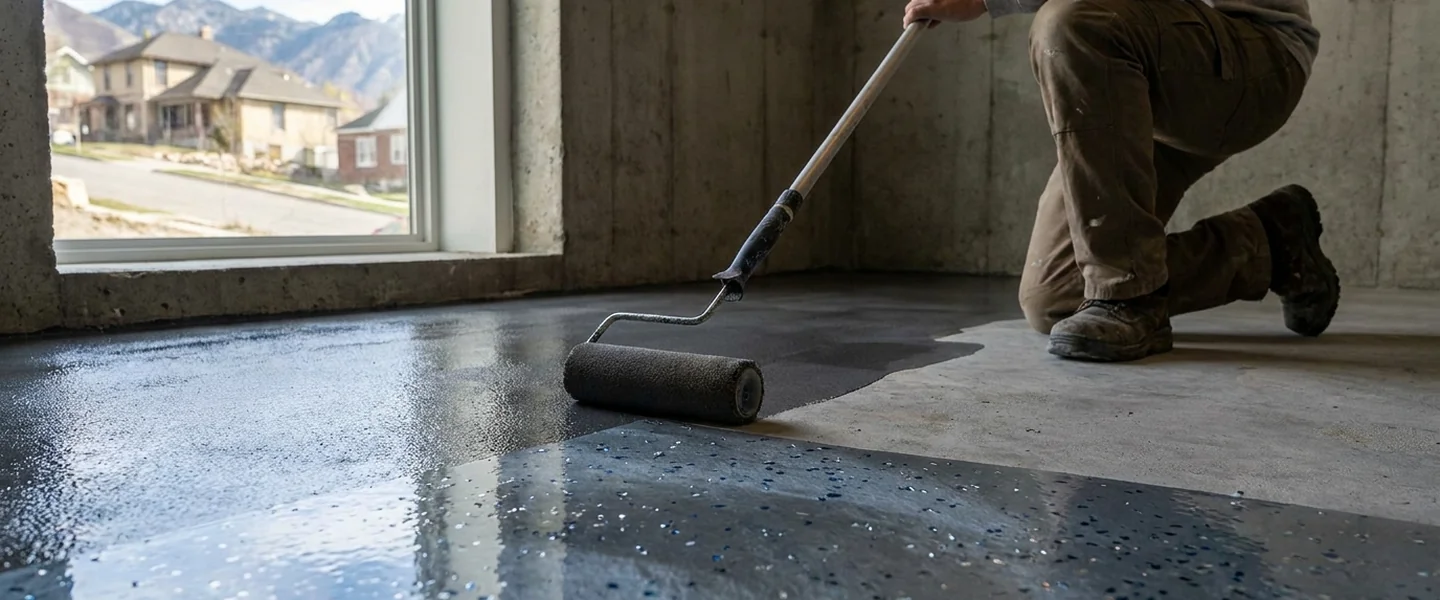
Basement Floor Epoxy Salt Lake City
Moisture-tolerant basement floor coating with vapor-block primer and slip-resistant aggregate. Built for Salt Lake Valley basements with seasonal water-table swings.
Basement floor epoxy is a different system from garage epoxy. Basements are below grade, the slab sees more moisture, the use case is different (finished living space vs. shop floor), and the failure modes are different (blistering and delamination from moisture, not hot-tire lift). We install moisture-tolerant basement floor coatings across the Salt Lake Valley specifically engineered for below-grade slab conditions, with vapor-block primer, slip-resistant aggregate, and polyaspartic topcoats. Call (385) 600-6216 for a free on-site estimate.
What Basement Floor Epoxy Means in Utah
Wasatch Front basements sit on alkaline soils that hold and move groundwater seasonally. The Great Salt Lake’s elevation, snowmelt from the Wasatch Range, and irrigation patterns in older neighborhoods all push the water table up and down over the year. Basement slabs in Salt Lake City, Murray, Holladay, and Bountiful frequently show seasonal moisture wicking even when the basement looks “dry” to the eye.
A coating system that ignores that moisture will blister, delaminate, and fail within a few seasons. The right basement coating uses a moisture-tolerant primer designed for high-MVE (moisture vapor emission) slabs, a basecoat compatible with that primer, and a polyaspartic or polyurethane topcoat that handles the chemical exposure of a finished basement (sometimes wine spills, sometimes laundry products, sometimes gym equipment lubricant). The Salt Lake City basement floor coating we install is built for all of that.
Project Details
| Timeline | Two to three days on site |
|---|---|
| Install Days | Day 1: grind, repair, vapor-block primer. Day 2: basecoat, flake or aggregate. Day 3: topcoat (if multi-coat system). |
| Materials | Moisture-tolerant vapor-block primer, 100%-solids epoxy basecoat, vinyl flake or quartz aggregate, polyaspartic topcoat |
| Warranty | 15-year topcoat warranty, 5-year workmanship, transferable |
| Crew Size | 2-3 installers |
| Permit Required | No permit for residential basement coating in Salt Lake City |
| Pricing | Quoted per job after free on-site inspection — every quote is itemized in writing |
Our Basement Floor Process
Moisture testing
Calcium chloride test, calibrated moisture meter readings at multiple points across the slab, and a visual inspection for past water signs (efflorescence, dark staining, mineral deposits at floor-wall joints). The test results determine whether you need a standard primer or a high-MVE primer.
Full diamond grind
Mechanical surface prep with HEPA dust extraction. Removes any existing sealers, paints, or surface contamination, and opens the concrete profile for primer adhesion.
Crack and divot repair
Polyurea crack filler in every crack, divots filled flush. Basement slabs often have spider-web cracking that needs attention before coating.
Vapor-block primer
Moisture-tolerant primer designed for high-MVE applications. This is the layer that stops blistering and delamination from moisture wicking up through the slab. Most basement coating failures in Utah come from skipping this step.
Basecoat, flake or aggregate broadcast
100%-solids epoxy basecoat with vinyl flake (residential look) or quartz aggregate (more slip-resistant for laundry or wet areas).
Polyaspartic topcoat and walk-through
UV-stable, chemical-resistant topcoat. Walk on it in 4 to 6 hours. Walk-through with you before signing the warranty.
Materials We Use on Salt Lake City Basements
| Vapor-block moisture-tolerant primer | Designed for high-MVE applications. Bonds to damp concrete and blocks vapor transmission through to the coating system above. |
|---|---|
| 100%-solids epoxy basecoat | Penntek or Wolverine system. Compatible with the vapor-block primer and the polyaspartic topcoat. |
| Vinyl flake or quartz aggregate | Flake for finished basement aesthetic. Quartz aggregate for more slip resistance in laundry rooms, gyms, and walk-out basements with water exposure. |
| Polyaspartic topcoat | UV-stable (matters in walk-out basements with daylight windows), chemical-resistant, scuff-resistant. |
Common Basement Scenarios in Salt Lake City
Finished basement with carpet ripped out
Common in older Salt Lake City and Murray homes — carpet pulled because of pet damage, mold, or just outdated style. Epoxy floor finishes the basement faster than tile or LVP and handles below-grade moisture better.
Walk-out basement with daylight
Holladay and Cottonwood Heights walk-outs with large windows and patio doors get UV exposure. The polyaspartic topcoat keeps the basement floor color-stable.
Basement laundry or utility room
Water from washers, slop sinks, and water heaters means slip resistance and moisture tolerance matter. Quartz aggregate basecoat with polyaspartic topcoat is the spec.
Home gym or workshop basement
Rubber mat damage, dropped weights, and chemical exposure from cleaning products. Polyaspartic topcoat handles all three. Quartz aggregate adds slip resistance and impact strength.
Why Salt Lake City Basements Need This Specifically
Below-grade slabs in the Wasatch Front sit on alkaline, often expansive soils with shallow water tables in older neighborhoods (especially in Murray, Bountiful, and parts of Salt Lake City proper near the old streamlines). The slab takes moisture wicking year-round and accelerated wicking in spring snowmelt season. A coating system without vapor-block primer treats those moisture-stressed slabs the same as a dry suburban garage — and fails within seasons.
Our basement system is specifically built for this. The vapor-block primer is the differentiator. It’s also the line item most cheap quotes leave out, which is how a cheap basement floor turns into an expensive do-over with significant damage when the original lifts a year later.
Warranty in Detail
15-year topcoat warranty, 5-year workmanship, transferable.
Covered
- Topcoat delamination, peeling, lifting
- UV chalking in walk-out basements with daylight exposure
- Chemical staining from common household chemicals
- Adhesion failure attributable to our install
Not covered
- Damage from active water intrusion through walls or floor cracks (we coat the slab — we don’t waterproof the basement)
- Impact damage from dropped equipment
- Coatings or sealers applied later by others
- Slab cracks caused by structural movement
If your basement has active water intrusion, the coating is not the right first project. We’ll tell you that during the estimate — you need waterproofing or drainage work first, then a coating goes down after the moisture is controlled.
How We Quote
Free on-site visit, moisture testing, slab assessment. We walk you through flake vs aggregate options and topcoat sheen choices. Written quote on the spot or within 24 hours. Call (385) 600-6216 to schedule.
Free Basement Floor Estimate
Same-week appointments across the Salt Lake Valley.
After the Install
30-day walk-through, 12-month follow-up. Basement floors typically need less ongoing maintenance than garage floors because they don’t see hot tires or road salt. Sweep monthly, mop quarterly with pH-neutral cleaner. Wipe up spills the same week.
Frequently Asked Questions
Can you coat over a damp basement floor?
With the right primer, yes — up to a point. Our vapor-block primer is rated for high-MVE applications. But “damp” has a limit. If we see standing water, active wicking, or efflorescence rebuilding within hours of cleaning, the basement needs waterproofing work first. We’ll tell you that honestly during the estimate.
Will the coating fix a leaky basement?
No. We’re not waterproofers. A coating goes over the slab; water comes through walls or floor cracks. Fix the water problem first, then coat. If the floor is dry to a moisture meter and the test results check out, we coat.
How long until I can use the basement?
Walk on it in 4 to 6 hours after the topcoat. Place furniture in 72 hours. Full chemical cure at one week. Plan to keep the basement empty for a long weekend.
Will it be slip-resistant for a laundry room?
Yes if we use quartz aggregate broadcast instead of standard vinyl flake. We can also add a polyurea slip additive to the topcoat. We’ll spec for slip resistance during the estimate based on use case.
Will the floor be warm or cold?
The coating doesn’t change the slab’s thermal properties — if the slab is cold, the coated floor will still feel cool. The advantage over tile is that epoxy is slightly less thermally conductive, so it doesn’t feel as cold underfoot as tile does.
Can you do colors?
Yes — 20+ flake blends, or pigmented basecoat colors for solid-color basements. We walk you through samples during the estimate.
How long does a basement epoxy floor last?
15 to 20 years with proper care. Less wear than a garage floor because there’s no vehicle traffic, no road salt, and minimal UV exposure (except walk-outs).
What does a basement floor coating cost?
Square footage, moisture levels, slab condition, and finish choice all change the number. Call (385) 600-6216 for a free inspection and written quote.
Related Reading
- Moisture Vapor Emission: The Silent Killer of Salt Lake City Garage Floors
- Polyaspartic vs Epoxy: What Lasts Longer in Salt Lake City?
Also serving Holladay, Bountiful, Murray, and the rest of the Salt Lake Valley.
What You Get in Our Quote vs. the Lowball Bid
We don’t compete on the lowest sticker price — we compete on the quote that gets the job actually done. Here is what is included in every quote we write, and the cut-corners that show up in cheaper bids.
Included in our written quote
- Concrete moisture + porosity testing
- Crack and pitting repair before coating
- Full diamond-grind surface prep
- Written quote with flake/coat specs
- Cure-time schedule you can plan around
- 5-year warranty against delamination
Cut corners in the lowball bid
- Coating over uncured or wet slab
- Roller-only prep (no diamond grind)
- Lowball quotes without crack repair
- Subbed-out installation
- No moisture testing before coat
- Warranties full of fine print